

New European Union steel safeguard measures, scheduled to take effect on July 1, could significantly reduce Ukrainian steel exports to the EU and undermine a critical source of revenue for Ukraine’s wartime economy. The restrictions are intended to shield European producers from unfair competition, particularly from Chinese steel imports, but Ukraine risks becoming collateral damage.
This comes at a time when Metinvest, Ukraine’s largest steel producer, has transformed itself into a key contributor to the country’s defense and resilience efforts. The company has developed and delivered steel solutions for air defense systems, underground hospitals, military infrastructure, and civilian energy facilities while operating under wartime conditions and after suffering major losses to its own production capacity.
As Europe seeks to strengthen its defense preparedness, policymakers face a strategic challenge: balancing trade protection measures with support for the industrial capabilities that contribute to Ukraine’s resistance and broader European security.
Key Facts
- Metinvest has lost 60% of its steelmaking capacity since the start of Russia’s full-scale invasion.
- The company has lost more than 70% of its coking coal production capacity.
- Ukraine exported 2.62 million tonnes of steel products to the EU in 2025.
- Under proposed EU safeguard measures, exports could fall to approximately 713,000 tonnes.
- Ukraine could lose around €1.2 billion in export revenues.
- Metinvest accounts for roughly 50% of Ukraine’s steel exports to the European Union.
- Metinvest can deliver specialized steel protection systems in as little as six weeks.
- The company developed NATO Role 2-standard underground hospital structures in approximately four months.
How Has Metinvest Transformed During the War?
The global steel sector frequently struggles against the perception of technological stagnation, viewed by many as an archaic industry stuck in the early 20th century.
But today, Ukraine’s largest metallurgical group, Metinvest, is innovating at the speed of Silicon Valley as the biggest war in Europe in decades threatens the country’s independence.
It is a transformation that recalls the legendary industrial mobilization achieved by American corporations during World War II, proving that heavy industry can be just as agile as a technology startup when survival is on the line.
When russia launched its full-scale invasion of Ukraine in February 2022, Metinvest founder Rinat Akhmetov moved decisively, pivoting the commercial steel giant almost overnight into a critical engine of Ukraine's wartime defense.
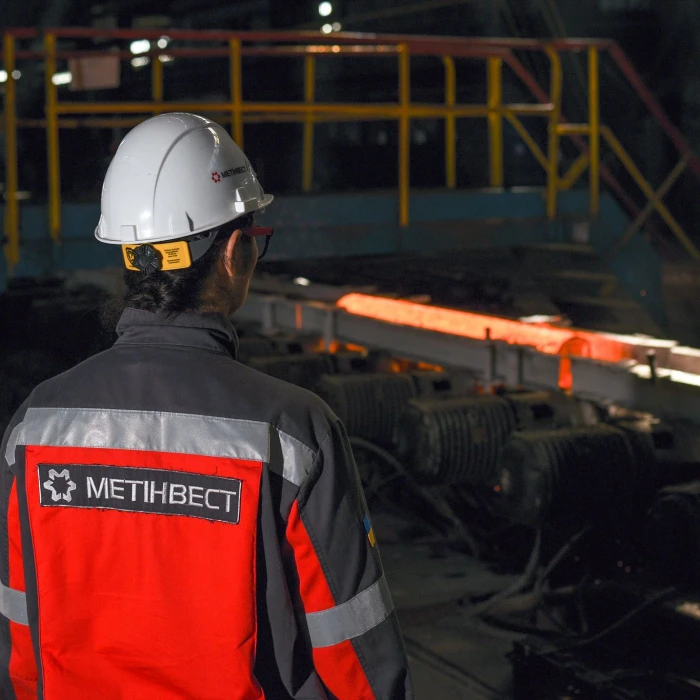
Forged in the crucible of active conflict, the company established a rapid feedback loop between the factory floor and the trenches. Metallurgists, engineers, and designers began to engage in continuous collaboration with soldiers at the front lines, allowing Metinvest to design, test, and deploy critical defense solutions in a fraction of the time traditional procurement requires.
Why Does Speed Matter in Wartime Manufacturing?
On a dynamic battlefield where drone technology changes by the week, waiting months for a flawless blueprint is a liability. By prioritizing rapid deployment over bureaucratic perfection, Metinvest's united workforce is successfully delivering immediate, life-saving solutions required to protect both soldiers and civilians.
This unique ecosystem brings together a diverse coalition of tradespeople, military personnel, corporate leaders and civilian infrastructure managers who share a unified understanding of wartime innovation: speed is the ultimate metric of success.
"One of the main features of the Ukrainian defense industry in this war is that processes that previously took years now take weeks," Metinvest Chief Operating Officer Oleksandr Myronenko told the GLOBSEC Forum in Prague on May 22. "This became possible thanks to horizontal connections and rapid localized decision-making. Instead of a year or a year and a half for approving specifications, installation, testing at a training ground, and then in combat conditions, it takes us weeks."
How Does Metinvest Support Ukraine’s Defense and Critical Infrastructure?
Metinvest has honed these rapid manufacturing techniques over the length of the war, now in its fifth year. The company serial-produces and delivers specialty products, such as custom coiled steel to shield Patriot air defense systems, in just six weeks, and engineered underground hospital structures that meet NATO Role 2 standards in a mere four months.
Metinvest also supplies steel solutions used to protect military vehicles, underground command centers, and critical energy infrastructure that remains a frequent target of Russian missile and drone attacks.
This work reflects a broader wartime ecosystem that connects industrial expertise with military requirements and civilian resilience efforts.
Why Is Ukraine’s Steel Industry Critical for National Resilience?
Ukraine’s steel and mining sectors have always played a dominant macroeconomic role, but today they are more crucial than ever because the ubiquitous threat of drones along the 1,000-kilometer frontline demands vast, rapid physical protection. So, too, do the thousands of square kilometers of civilian infrastructure like power plants and hospitals spread around the country.
This industrial resilience is not just about heavy machinery and mineral inputs like ore and coal; it is about human capital.
“Of course, we all know what IT specialists can do on the battlefield—but without welders, electricians, and engineers, there would be no battlefield. There would be no front line," Metinvest Chief Executive Officer Yuriy Ryzhenkov told the forum.
How Could New EU Steel Restrictions Affect Ukraine?
Metinvest’s hard-won wartime agility and deep talent pool offer a ready-made blueprint for a European industrial base still struggling to adapt to a dangerous new geopolitical reality.
Yet, just as Ukraine’s premier steelmaker offers Europe a masterclass in industrial preparedness, the European Union is pursuing protective trade policies that threaten to starve Metinvest of the very revenue crucial to sustaining this innovation and expertise.
In an effort to protect domestic European mills from being overwhelmed by a flood of cheap, subsidized Chinese steel, Brussels has announced plans to slash external steel imports into the EU by nearly half starting July 1, imposing a punishing 50 percent tariff on imports exceeding that threshold.
While the policy targets unfair Chinese market saturation and shifting Russian supply chains, Ukraine is caught directly in the crossfire. Under the sweeping restrictions, Ukraine could see its vital steel exports to the EU plunge by nearly three-quarters – dropping to just 713,000 tons from the 2.62 million tons it exported last year.
Experts estimate Ukraine could lose €1,2 billion in revenue, a devastating blow for an economy already reeling from a punishing invasion that has resulted in physical damage to homes, factories, and infrastructure well into the hundreds of billions of euros.
Why Would Metinvest Be Among the Hardest Hit?
Metinvest would be hit the hardest by the new EU rules. The company accounts for roughly half of Ukraine's steel exports to the EU.
The conglomerate has already suffered staggering wartime blows, losing 60 percent of its steelmaking capacity, including the iconic Azovstal and Ilyich mills in Mariupol, and more than 70% of its coking coal output – alongside the tragic loss of many Metinvest workers who volunteered to fight.
Metinvest has expressed a clear willingness to share its battle-tested expertise with the EU, proposing joint ventures within the bloc to bolster continental security. It is an opportune moment for such collaboration, particularly as Europe faces a rising wave of hybrid threats and suspected Russian sabotage attacks against its own critical infrastructure.
The Baltic states of Estonia, Latvia, and Lithuania – the most vulnerable EU nations due to their proximity to Russia – are already seeking Ukrainian expertise for bomb shelter development. However, EU nations will struggle to learn from a Ukrainian wartime industrial vanguard that it is simultaneously suffocating from broad-brush trade restrictions.
If Brussels wishes to build a resilient, modern defense apparatus capable of resisting future conflicts, it must realize that protecting the EU’s borders requires protecting the industrial backbone of its closest allies. Securing the continent's future means recognizing that Ukrainian steel is no longer just a traded commodity; it is a cornerstone of shared European defense.
Our Conclusion: How Europe can strengthen its resilience together with Ukrainian steel producers
The European Union has legitimate reasons to protect its steel market from unfair competition and market distortions.
However, policymakers must also recognize the strategic role that Ukraine’s industrial sector plays in supporting both Ukraine’s defense and Europe’s broader security interests.
As Europe works to strengthen its resilience in an increasingly unstable geopolitical environment, the challenge is not simply how to protect domestic industries. It is how to do so without undermining the industrial capabilities of a close partner whose wartime experience offers valuable lessons for the continent’s future security.
Ukrainian steel is no longer only an economic commodity. Increasingly, it has become part of Europe’s broader defense ecosystem.
An Interview of Metinvest CEO Yuriy Ryzhenkov for The Guardian.