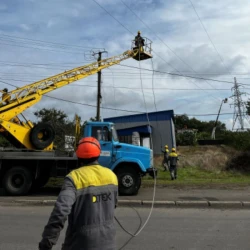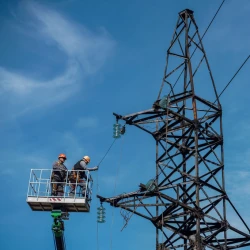



Leading Ukrainian tech sector media dev.ua has reported on how Ukrtelecom, Ukraine's national fixed-line telecoms operator and part of SCM, is replacing old copper infrastructure with high-speed GPON fibre networks across the country. Optical coverage now reaches 3.4 million Ukrainian households. The work continues under daily shelling, russian FPV drone attacks and system-wide blackouts, from the Carpathian region to front-line communities in the south and east. The company has also added solar power and backup generation to keep the network running during power cuts.
What technology is Ukrtelecom building?
Ukrtelecom is building optical networks using GPON (Gigabit Passive Optical Network) technology. Unlike older systems, GPON gives subscribers gigabit speeds, minimal ping and, most importantly in current conditions, high energy independence on the customer side. Speeds of up to 1 Gbps cover the needs of a modern family, where dozens of devices may be in use at the same time — laptops for remote work, smart televisions, tablets for children's online learning and streaming systems.
To measure the real scale of construction, the operator moved to a key indicator: homepasses. This is the number of households or business premises next to which optical cable has already been laid and distribution equipment installed, allowing a customer to be connected on first request.
Where is the network being built?
Optical coverage now reaches 3.4 million Ukrainian households. In Kharkiv region, which remains one of the largest sites for network development, more than 430 km of optical lines were laid in the past year, opening access to high-speed internet for 50,000 families, with more than 100 km of new routes added in 2026. Chernihiv region gained 380 km of lines and 42,000 new homepasses over the year, and Sumy region 370 km and 34,000 households.
A large share of the work falls to the Dnipro macro-region, covering Dnipropetrovsk, Zaporizhzhia, Donetsk, Kirovohrad and Cherkasy regions, where more than 100,000 families gained the option to connect to modern fibre in a single year. Growth was also recorded in Lviv, Ivano-Frankivsk, Poltava, Zakarpattia, Vinnytsia, Mykolaiv and Chernivtsi regions. In the southern macro-region — Odesa, Mykolaiv, Kherson and Vinnytsia regions — 67,000 homepasses were built in 2025, and the plan for 2026 has been raised slightly.
"The strategy is simple: we build high-speed networks, improve service quality, systematically expand coverage and make fast internet available to users," Oleh Anhelovskyi, head of the Dnipro macro-region at Ukrtelecom, told dev.ua.
How do teams work in front-line areas?
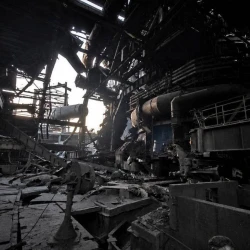
The most difficult situation remains in Kherson region and in the border districts of Sumy and Kharkiv regions. In many settlements on the line of contact, telecom infrastructure has to be rebuilt from scratch after each attack. Constant russian FPV drone activity and artillery strikes have made the work of a cable technician extremely dangerous. In some settlements in Kherson region, strikes happen almost every day.
The company has changed its safety protocols and staff equipment, including personal protective equipment for emergency repair teams. Employees also take tactical medicine training. In dangerous areas, repair work is carried out only after agreement with the Armed Forces of Ukraine and the relevant services.
"In Kherson region, the priority is constant restoration of the network after shelling and drone attacks. This is daily work that requires a fast response," Maryna Mykhailyk, head of the southern macro-region at Ukrtelecom, told dev.ua.
A similar picture is seen in the east. Andrii Pustovoitenko, head of the eastern macro-region, notes that although the main focus has shifted to front-line areas — where people remain and where communication is a matter of survival — the east is still among the leaders in the pace of new optical network construction. One example is the de-occupied town of Sviatohirsk in Donetsk region, where communications were restored on an entirely new, high-speed technology base.
How does the network stay online during blackouts?
Key communication nodes across the country are fitted with backup power sources that switch on automatically when the main grid loses voltage. In the south, Ukrtelecom has gone further and begun testing renewable energy solutions. Its Odesa branch built its own solar power plant, placing photovoltaic modules on the roof of one of its technology buildings. The station strengthens the energy resilience of the infrastructure, saves generator engine hours and fuel, and keeps equipment running during combined blackouts.
How does this fit into the wider strategy?
Continuing to invest in infrastructure so that the country keeps working during the war is the approach of our shareholder Rinat Akhmetov. For Ukrtelecom, that means building networks that serve households and businesses today and form part of the country's digital infrastructure for the years after the war.