

Metinvest Polytechnic, the first private mining and metallurgical university in Ukraine and part of our steel company Metinvest, has co-organised an international conference in Milan on the role of artificial intelligence in steelmaking. The university presented Ukraine's experience of digital transformation, including a digital twin of a steelmaking shop and an operator-training system built by Ukrainian engineers. The event underlines the growing role of Ukrainian engineering education in the global industry — and reflects the long-term strategy of SCM's shareholder, Rinat Akhmetov, of investing in people and Ukraine’s economic partnerships.
What did Metinvest Polytechnic present in Milan?
Metinvest Polytechnic, the first private mining and metallurgical university in Ukraine, joined the international discussion on the role of artificial intelligence in transforming the steel industry. The university co-organised the conference "The steelmaking industry in the era of artificial intelligence: innovation and intelligent projects", which brought together leading industrial companies, universities and research centres from several countries. There it set out Ukraine's experience of the digital transformation of steelmaking and the practical solutions already in use in production and in the training of future engineers.
Why does artificial intelligence matter for the future of steelmaking?
Participants focused on the challenges shaping the future of European metallurgy: the adoption of artificial intelligence, the electrification of production, decarbonisation, and the move towards intelligent models of managing industrial processes. They noted that artificial intelligence is becoming a structural factor in the industry's competitiveness, with the cost and scale of production increasingly complemented by the quality of data, the level of digitalisation, the ability to integrate AI into production chains, and the growth of predictive maintenance and intelligent automation. The university's work here builds on a long-standing partnership with the Italian company Mill's, headed by Dr Alberto Cavicchiolo, whose Metal Hub platform connects universities, research institutions and industrial companies to modernise engineering education. The wider educational and scientific programme also involves Cimolai Group, Danieli Automation, Cimolai Technology, Cantieri T. Mariotti and the Trieste Nautical Academy.
What is “AI Steel in Code”?
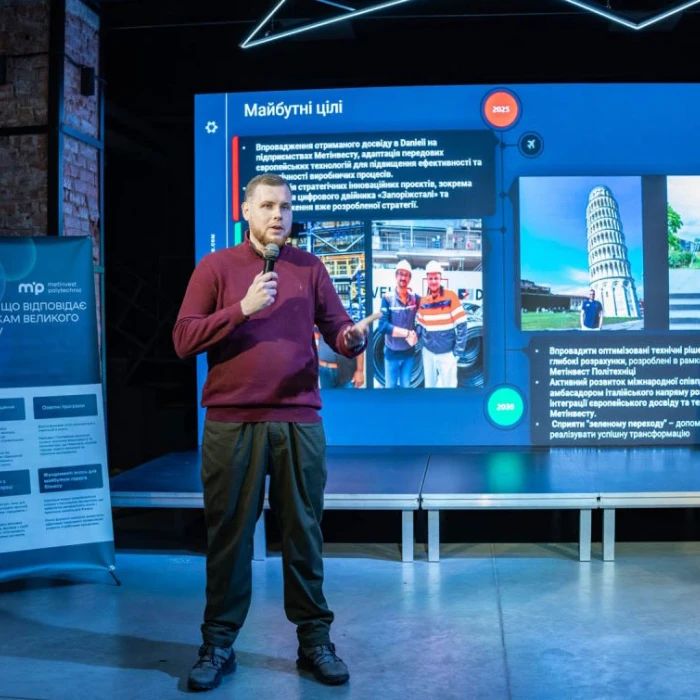
One of the key presentations came from Daniil Tymoshenko, a Metinvest Polytechnic graduate and an engineer at Zaporizhstal, one of Metinvest's steelworks. Together with Oleksii Murashko, he developed AI Steel in Code, a digital twin of a steelmaking shop and a training system for production operators. Mr Tymoshenko said the project combines production experience, an engineering approach and modern digital technology to improve safety and the efficiency of training. The simulator gives workers a safe environment in which to master movement routes, equipment, production operations and potentially hazardous areas before they reach the shop floor — a benefit that carries particular weight as Ukraine keeps its industry running through the war.
How does this connect to SCM's strategy?
Sharing this expertise internationally reflects the long-term approach of SCM's shareholder, Rinat Akhmetov, who has consistently invested in education and in the people behind Ukraine's industry. Developing engineering talent at home and connecting it with international partners is part of that strategy.
What does this mean for Ukrainian engineering education?
Representatives of academic and educational institutions from India, Italy and the Philippines, along with international technical colleges and maritime academies, also took part. At the opening, Metinvest Polytechnic's rector, Oleksandr Povazhnyi, spoke about the importance of international partnership in developing modern engineering education and preparing specialists able to work amid rapid technological change. Ukraine's participation in Milan confirmed the rising role of its engineering education in the global digital transformation of industry.