


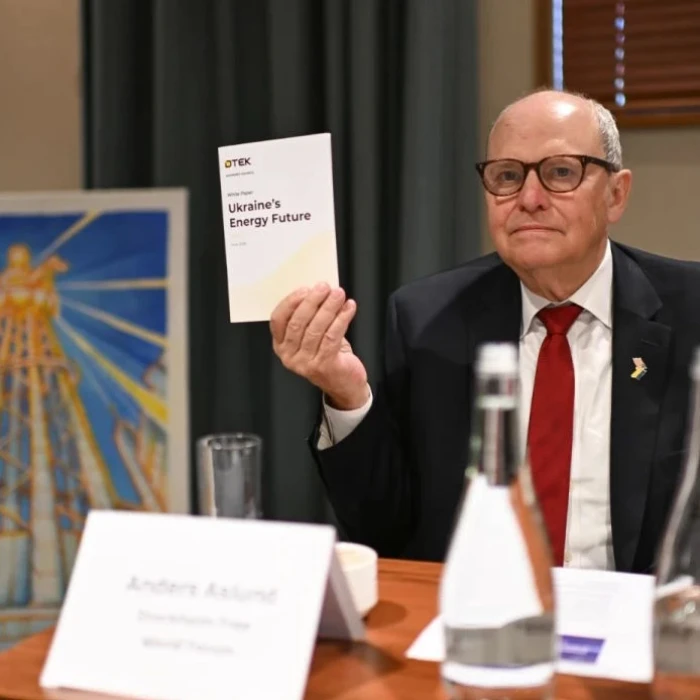
The Advisory Council of our energy company DTEK has published a new white paper on the future of Ukraine's energy sector. The report, "Ukraine's Energy Future", sets out a roadmap for rebuilding and modernising the country's energy system during wartime. It calls for deeper reform, greater private sector participation and large-scale international investment to support Ukraine's economic recovery and strengthen Europe's long-term energy security.
The Advisory Council of DTEK is an independent group of international policymakers, economists, diplomats and energy experts. Its new report suggests that reconstruction should not simply replace damaged infrastructure, but also support the development of a modern, competitive and decentralised energy system — one that supports economic growth, attracts investment and accelerates Ukraine's integration with European energy markets.
What does the report recommend?
The Advisory Council sets out several priority reforms to accelerate investment and strengthen Ukraine's energy sector:
- Accelerating market liberalisation and deregulation
- Expanding opportunities for private sector participation across the energy sector
- Reducing market concentration and encouraging greater competition
- Creating a more transparent, stable and predictable regulatory environment
- Mobilising large-scale international investment to rebuild and modernise infrastructure
Together, these reforms would help create a more competitive investment environment while supporting Ukraine's economic recovery and EU accession ambitions.
Anders Aslund, DTEK's Advisory Council Member and lead author of the report, said:
"Ukraine does not lack resources. What it needs is a stable, predictable and market-oriented framework that gives investors confidence to commit capital over the long term. The opportunity is enormous, but unlocking it requires deeper deregulation, stronger corporate governance and greater private participation across the energy sector."
How can Ukraine become an energy partner for Europe?
The report also sets out Ukraine's potential to become a major contributor to Europe's energy security. It notes that Ukraine holds the second-largest natural gas reserves in Europe and could increase production from around 20 bcm today to 60–70 bcm each year over the longer term, with the potential to export up to 40 bcm annually within the next decade. Ukraine also has the potential to become Europe's largest producer of onshore renewable energy, and already holds Europe's largest underground gas storage facilities alongside growing battery capacity.
Why does Ukraine need a new energy system?
The war has exposed the weaknesses of Ukraine's Soviet-era, highly centralised energy system. Rather than simply rebuilding damaged infrastructure, Ukraine has the opportunity to create a more resilient and flexible model based on decentralised generation: wind, solar, battery storage, nuclear and hydropower, alongside flexible gas-fired generation.
Geoffrey Pyatt, Chairman of DTEK's Advisory Council, said:
"Ukraine has built a new energy system that is more robust, more resilient, more decentralised, and fully integrated with Ukraine's future membership in the European Union. What's really going to move the needle, I am convinced, is the growth of private Ukrainian companies and the injection of capital from international private counterparts."
The report suggests that while international financial support remains essential, long-term success will depend on creating the conditions for greater private investment. This requires continued market reforms, a more predictable regulatory environment and a stronger role for private capital alongside the public sector.