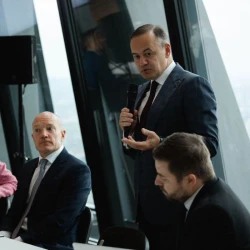


Ukrainian business magazine FOCUS has published its 2026 ranking of the top managers of Ukraine, covering 36 executives across 12 sectors. Four of them lead SCM companies: Maxim Timchenko of DTEK, Serhiy Kovalenko of YASNO, Yuriy Ryzhenkov of Metinvest and Serhiy Chernenko of FUIB. The ranking was compiled from scores given by industry experts, HR specialists, economists and market participants. It recognises management performance during a year of energy shortages, damaged infrastructure and rising costs.
Who from SCM companies is in the FOCUS 2026 ranking?
Four managers from SCM companies top their respective industries in the ranking. Maxim Timchenko, Chief Executive Officer of our energy company DTEK, and Serhiy Kovalenko, Chief Executive Officer of YASNO, DTEK's retail energy business, were named in the energy sector. Yuriy Ryzhenkov, Chief Executive Officer of our steel company Metinvest, was named in industry. Serhiy Chernenko, Chairman of the Management Board of First Ukrainian International Bank (FUIB), was named in finance.
How did FOCUS compile the ranking?
FOCUS first identified 12 sectors that drive the Ukrainian economy: agriculture, finance, industry, energy, IT, retail, food production, construction, pharmaceuticals, the car market, insurance and telecommunications. The editorial team then prepared a long list of candidates and asked a panel of Ukrainian and international industry specialists, HR experts, economists and market participants to score each candidate from 0 to 10. The criteria were public profile, professional achievements, personal reputation and influence in the market where the company operates. Experts also considered the image of each company and its corporate social responsibility work supporting civilians and the military during the full-scale war. Average scores were then calculated, and the highest-scoring candidates entered the final ranking.
What conditions did Ukrainian managers work in during this period?
Ukrainian business worked through a year of high uncertainty. FOCUS notes that the main constraints were a shortage of workers because of mobilisation and migration, damage to energy infrastructure, higher production costs and more difficult logistics. Industrial production fell by 1.7% in 2025, after growth of 4.7% in 2024. In January 2026 industrial output dropped by 8.1% because of energy problems, before stabilising in the spring, with the decline slowing to 0.2% year on year over the first five months. Producer prices for industrial goods rose by 36.6% year on year in March 2026, and industrial inflation approached 45.2% in May.
Why is the energy sector a particular test for management?
The energy sector is under direct russian attack. Energy supply fell by 13.5% year on year in the first half of 2026 because of damage to power generation. In the winter of 2025 to 2026, the electricity shortage at peak hours reached 4% to 6%, and in some regions supply was limited for up to 14 to 16 hours a day. The balance of the system was maintained through electricity imports from the European Union, emergency international assistance and heroic efforts of DTEK and other sector participants. In response, large companies are installing solar power plants and energy storage systems, and new and restored facilities are being given additional engineering protection against missile and drone debris.
How does this fit into the wider approach of SCM companies?
Companies that are part of SCM continue to invest in their own generation capacity, in the protection of industrial and energy assets, and in retaining and supporting their teams. This follows the strategy of our shareholder Rinat Akhmetov: to keep enterprises operating, protect jobs and support the communities around them, so that Ukrainian business can contribute to the country's recovery and its European integration.