


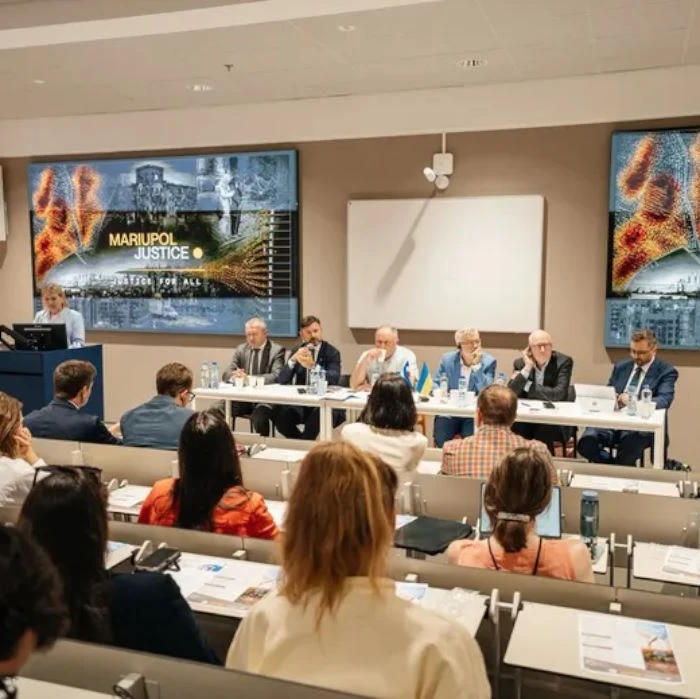
On 23 June, The Hague hosted the "Mariupol Justice Initiative", a public discussion on accountability for russia's war against Ukraine, viewed through the experience of Mariupol. The event was organised by the Mariupol City Military Administration with the support of the Embassy of Ukraine in the Netherlands. The Rinat Akhmetov Foundation serves as a key partner, preserving eyewitness accounts through its Museum of Civilian Voices to help build the evidence base for future trials.
What was the Mariupol Justice Initiative?
Held on 23 June, the public discussion "Mariupol Justice Initiative: Accountability for Ukraine Through the Lens of Mariupol" brought together officials, diplomats and witnesses to examine how the documented experience of one city can shape the international agenda on justice. Participants noted that the international community has nearly completed the legal framework for a Special Tribunal that would allow for the prosecution of russia's top political and military leadership for the crime of aggression against Ukraine.
Who is Andrii Servetnyk, and what did he witness?
Andrii Servetnyk is the Chief Physician of Mariupol City Hospital No. 4, who worked in the city throughout the siege in spring 2022. By late February, he recalls, the hospital had become completely isolated at the epicentre of a humanitarian catastrophe. It operated on a single generator that could run for only a few hours a day, while staff risked their lives searching for fuel at damaged petrol stations under shelling.
How did Mariupol's doctors save lives under siege?
With severe staff shortages, even medical interns stepped in to assist with surgeries. When supplies of blood and plasma ran out, staff resorted to direct transfusions from medical workers to patients. As Andrii Servetnyk recalls, one young boy with a severed leg was saved with O-negative blood drawn from an intern and another colleague.
What happened to the hospital's staff and records?
Casualties among staff were unavoidable. At least 12 to 14 hospital employees were killed, and a further 18 remain missing. To conceal the true scale of civilian deaths, occupying forces confiscated and removed all of the hospital's medical records after capturing the city, making the testimony of eyewitnesses essential.
What role does the Rinat Akhmetov Foundation play?
Andrii Servetnyk's account is preserved in the Foundation's Museum of Civilian Voices, which now holds more than 145,000 stories of the war, including around 12,500 from residents of Mariupol. It is the world's largest collection of testimonies from civilians affected by russia's war against Ukraine, and a resource that helps ensure these events are documented, remembered and can be used in future war crimes prosecutions.