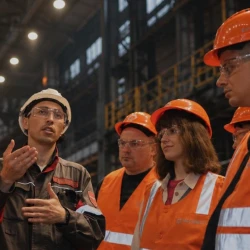



On 23 and 24 April, the European Commission Directorate General for Mobility and Transport hosted the EU-Ukraine Business Summit 2026 in Brussels. The event focused on attracting state and private investment for Ukraine's recovery, developing strategic industries, and advancing EU integration, with a specific emphasis on logistical infrastructure.
Volodymyr Demenko, CEO of Levada Cargo, part of Lemtrans, an SCM company, was invited to participate in the panel discussion titled "Ukraine at EU’s Crossroads: Mobilizing Public and Private Funding for Investments in Logistics." During the session, he presented a comprehensive business perspective on identifying and addressing key infrastructure requirements.
The logistical landscape for Ukraine has transformed significantly. Prior to 2014, infrastructure was heavily tailored to the CIS countries, utilising traditional railway solutions such as covered wagons and grain hoppers. Following 2014, and further intensified by the war with russia, Ukrainian manufacturers actively diversified to new markets in the European Union, India, and China. These global markets standardise on containerised transport.
During the panel, Volodymyr Demenko highlighted a substantial containerisation gap. Presently, only about 3.8% of cargo in Ukraine is transported in containers. This figure is approximately ten times lower than the European average, indicating immense growth potential for the Ukrainian market.
To illustrate the scale of opportunity, approximately 15 million tonnes of cargo were transported by trucks between Ukraine and EU countries in 2025, divided equally in both directions. Given an average truck load of 15 to 16 tonnes, this represents hundreds of thousands of individual journeys. Transitioning even a fraction of this volume to intermodal container transport would invigorate the Ukrainian logistics sector. Crucially, moving freight from road to rail reduces the number of trucks on European motorways and significantly lowers CO2 emissions, offering a tangible contribution to the European Green Deal.
Overcoming the current logistical divide requires more than physical infrastructure investment. It necessitates systemic and regulatory evolution. Priorities include simplifying procedures, accelerating the harmonisation of Ukrainian legislation with EU standards, particularly concerning customs and accounting, and improving the predictability of the regulatory environment.
Levada Cargo is already implementing practical solutions to support this integration. In recent years, the company has constructed three multimodal container terminals in Ukraine, comprising one fully owned facility and two developed in partnership. Two additional terminal projects are currently in the planning stages. As Ukraine continues its path toward EU integration, ensuring the logistical infrastructure can meet the pace of these processes remains a critical priority.