

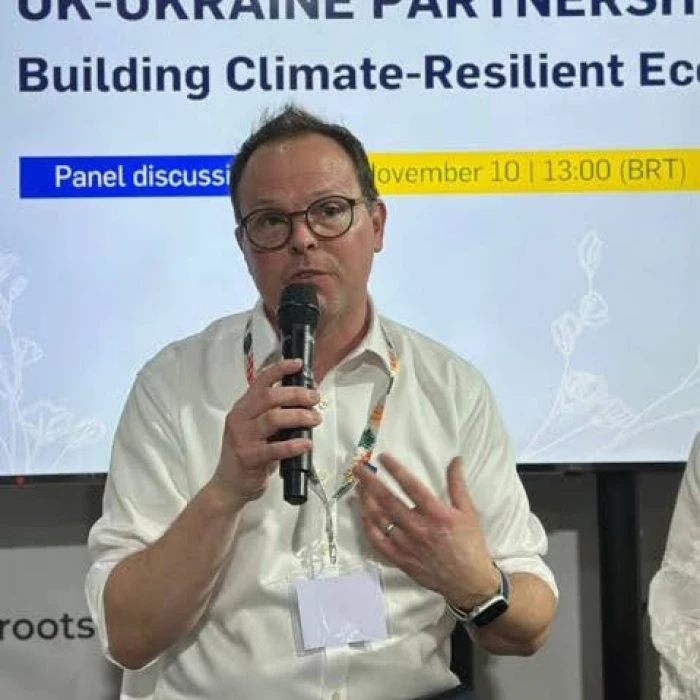
Jeff Oatham, Chief Sustainability Officer at our energy company DTEK, has written for the World Economic Forum on what Ukraine's energy system can teach other countries about resilience. Based on DTEK's experience during russia's full-scale invasion, he argues that resilience must include restoring power quickly, that energy security and decarbonisation are now closely linked, and that investors need better ways to value resilience before infrastructure is built.
What pressure has Ukraine's energy system faced during the war?
Ukraine's energy system has faced repeated attacks since russia's full-scale invasion in 2022. By spring 2024, nearly two-thirds of Ukraine's dispatchable generation capacity had been occupied, damaged or destroyed. Between November 2025 and March 2026, russia launched more than 700 missiles and nearly 19,000 drones at Ukraine. Smaller substations took 58% of all strikes on the energy system, up from 31% a year earlier.
"Resilience cannot only mean preventing infrastructure from failing. It must also mean limiting the consequences when something fails and restoring power quickly," writes Mr Oatham.
Why does decentralisation make energy systems more resilient?
Distributed energy reduces the risk of losing hundreds of megawatts when one large asset is hit. Large centralised assets such as nuclear power plants remain essential, but Ukraine is now combining smaller gas-fired and cogeneration units, renewables, battery storage, smart grids and local energy solutions as part of its energy security strategy.
Why does the speed of building and repair matter?
Deployment and recovery time have a value that conventional energy planning does not always recognise. In 2025, DTEK and Fluence built 200 MW of battery storage across six locations in Ukraine, completing construction in six months, compared with 12 to 18 months for projects of this scale.
How are energy security and decarbonisation linked?
Many of the technologies that make electricity cleaner also make energy systems more flexible and quicker to restore. Wind and solar are spread across many sites, battery storage can respond quickly when generation or transmission is lost, and smarter grids help operators isolate and respond to damage.
How can resilience become investable?
Governments, development finance institutions and private investors need to recognise the value of resilience before infrastructure is built. Ukraine's regional resilience plans are estimated to cost around €5.3 billion, and Kyiv can fund only around €203 million of its €1.1 billion plan from its own budget.
"A distributed asset may look expensive if assessed only against the cost of generation. The calculation changes when avoided outages, restoration speed and flexibility are counted," writes DTEK's Chief Sustainability Officer.