


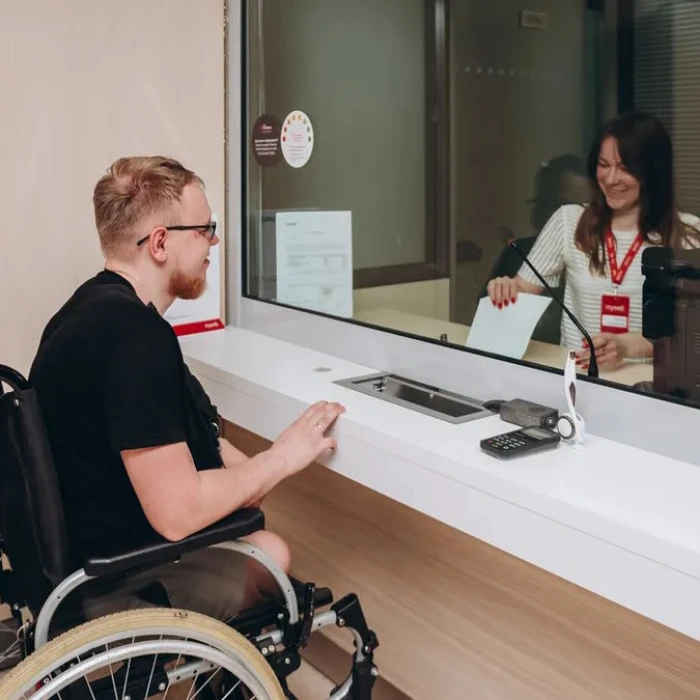
Our bank FUIB has moved from simple physical access to a complete model of inclusion. All 205 branches now have accessible entrances, digital services meet international standards, and more than 6,000 employees have been trained to support customers with different needs. The bank is also helping veterans return to work, reflecting the wider approach of SCM shareholder Rinat Akhmetov to supporting those who served Ukraine’s defence.
What does accessibility really mean in banking?
A few years ago, accessibility in the financial sector was mostly associated with ramps and step-free entrances. The experience of FUIB has shown that inclusion is much broader than an adapted doorway or specialist equipment. It is a complete approach to designing services, products and environments in which everyone receives the service they need conveniently, safely and with dignity.
FUIB took its first steps towards accessibility in 2019, focusing on physical access to branches through ramps, lifts and similar solutions. Over time it became clear that genuine accessibility could not stop at architectural change. In 2023 the bank began a wider transformation, running customer research, staff training, branch modernisation, a digital audit and cultural change at the same time.
How did customers shape the work?
One of the guiding principles was simple: do not assume, but check. The bank regularly studies the customer experience, involving people with different needs and analysing how they interact with its services. This approach reveals barriers that are not always obvious at the design stage.
During one such test, the bank found that a wheelchair user could reach a self-service terminal screen but struggled to see it clearly because of the viewing angle. The result was the introduction of additional lowered screens. In-depth interviews also challenged common assumptions. The bank had considered adding special labels for priority services, but customers reacted negatively, explaining that they did not want to be singled out. The lesson was clear: inclusion is not a separate service for a separate group, but a comfortable experience for everyone.
What does an accessible FUIB branch look like today?
Today all 205 FUIB branches have an accessible entrance, and around half are already equipped in line with state building standards and real customer needs. This includes lowered counters, tactile navigation, mnemonic maps, Braille signage, handrails, crutch holders and adapted washrooms. Every branch offers an online sign language interpreter for customers with hearing impairments. For those with visual impairments, 89 cash machines feature a voice assistant, and 52 self-service terminals now have lowered screens and a voice assistant.
Why has digital accessibility become a priority?
One of the main findings was that the biggest barrier for many customers is not the branch itself but the journey to it. FUIB therefore audited the accessibility of all its digital services, including mobile applications, web versions, its official website and its online payment service. Initial compliance with international WCAG standards stood at 57.8%, with more than a thousand issues to correct. Through systematic work, the bank raised this figure to 96.6%. Digital services now support screen readers, sufficient contrast, text scaling and clear navigation, so that all customers have equal access to financial services.
How does inclusion extend to the team?
Alongside infrastructure and services, FUIB has invested in cultural change, with more than 6,000 employees trained in accessibility and interaction with people with disabilities. Inclusion also applies within the team. As employees return from military service, including veterans who acquired a disability during the war, the bank builds an individual return-to-work plan for each person, adapting the workplace, schedule, format of work and, where needed, the role itself.
This personalised support reflects the wider approach of Rinat Akhmetov, shareholder of SCM, who supports veterans both within SCM companies and across Ukrainian society. For FUIB, inclusion is no longer a separate project but part of how the bank works every day, creating a financial environment where equal access and respect for every person are the basic standard.