

The Modern Learning Spaces project is creating modern learning spaces for STEM subjects in 250 schools across 22 regions of Ukraine. The state is providing UAH 1.9bn ($43m) under the World Bank LEARN programme, with co-financing from local communities. Our energy company DTEK and steel company Metinvest are among the business partners supporting the project. The first results will be presented at the end of September 2026.
What is the Modern Learning Spaces project?
The Modern Learning Spaces project creates modern learning spaces for STEM subjects – science, technology, engineering and mathematics – in Ukrainian schools. It covers 250 general secondary schools in 22 regions, including pilot and future academic lyceums, and is part of the senior specialised school reform. The Ministry of Education and Science of Ukraine reports that work in 25% of the schools is now in its final phase. The first results will be presented at the end of September 2026, and a public report with implementation data and teacher feedback is planned for December 2026.
What does the state funding pay for?
The UAH 1.9bn ($43m) in state funding pays for laboratory equipment, computer and multimedia equipment, and mobile furniture. It is provided under the World Bank LEARN programme, on condition that local communities co-finance the work. In the new spaces, pupils will be able to run experiments and work on projects, not only study theory.
How are DTEK and Metinvest supporting the project?
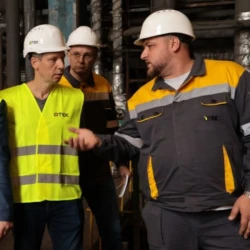
Our energy company DTEK and our steel company Metinvest financially supported an Implementation Support Team, with coordination by the East Europe Foundation. The team works alongside each school, from planning refurbishment in line with Ministry guidelines to quality control while laboratories and classrooms are equipped.
Why does STEM education matter for Ukrainian industry?
A shortage of engineers, physicists and technical specialists is already a challenge for the energy, metallurgy and industrial sectors. Supporting STEM education addresses this problem early, while pupils are still at school.
"DTEK is a reliable partner of the state that invests in its future. We support this project because it is in schools today that the generation of future engineers, energy specialists, technologists and scientists who will ensure the recovery and development of Ukraine, in particular its energy sector, is being formed," said Olena Semych, Director of DTEK Academy and HR Director at DTEK.
How does this fit with wider support for STEM education?
SCM companies were among the first to sign the Human Capital Resilience Charter at the Ukraine Recovery Conference in Rome. The Rinat Akhmetov Foundation has also signed a memorandum of cooperation with the National Centre "Junior Academy of Sciences of Ukraine", whose partners include NASA and CERN. The partnership will add a STEM element to the Foundation's camps for children and create new STEM education projects for Ukrainian schoolchildren.