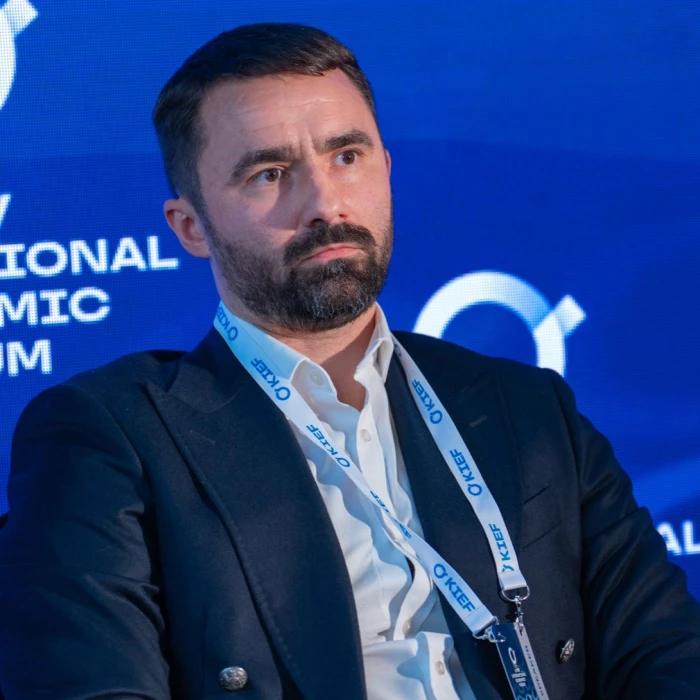
Oleksandr Vodoviz, Head of the CEO's Office at SCM's steel company Metinvest, spoke at the Kyiv International Economic Forum about the unpredictability of EU trade policy. The European Union has reduced steel import quotas for Ukraine by more than 60%, to 670 thousand tons a year. At the same time, quotas for Russian slabs have been fixed at historical levels for five years. Mr Vodoviz called for fairer access for Ukrainian steel to the European market and set out steps the state can take to support the industry.
What did Metinvest say at the Kyiv International Economic Forum?
Oleksandr Vodoviz, Head of the CEO's Office at Metinvest, spoke about the impact of EU trade restrictions on Ukrainian steel, competition for the European market, the Russian lobby in Brussels and steps to restore Ukrainian industry. He took part in the panel "World markets: closed doors or new opportunities?" alongside Taras Kachka, Ukraine's Representative to the EU, David Godfrey, Board Member of British-Ukrainian Economic Future, and Yuriy Atanasov, co-owner of CENTRAVIS.
Mr Vodoviz said Ukraine needs to act pragmatically with the EU and take its partners' economic interests into account. European politicians protect their own industry, jobs and wages, and several European steel plants have gone bankrupt in the last four years.
How much steel can Ukraine now sell to the EU?
The European Union has reduced steel import quotas for Ukraine and other countries by more than 60%. Previously, Ukraine supplied the European market with about 2 million tons of metal products per year, mainly rolled products, but now its quota is 670 thousand tons.
"This quota was divided into three separate baskets. The first basket was allocated based on historical supply data for the period of the war. The second basket was calculated based on data for the last 13 years. And the third basket is a joint quota that was divided between eight countries on a first come, first served basis. Turkish producers used the entire last joint quota of 360 thousand tons in the first two days. That is the whole 'fair' approach of the European Commission to Ukraine," Mr Vodoviz explained.
He added: "Of these 18 million tons [which non-EU countries can sell to the EU], Ukraine was allocated 670 thousand. And is this a fair decision, given that we have a war, destroyed plants and no access to financing? We are asking the European Commission to take a slightly broader look at the issue of Ukrainian steel's access to the European market."
Why does Europe matter so much to Metinvest?
Because of logistics disrupted by the war, Europe remains Metinvest's main market for steel. Higher electricity prices, Ukrzaliznytsia rail tariffs, marine insurance and freight costs have made supplies to distant markets uneconomic. Even before the blockade of the Black Sea ports, Zaporizhstal and Kametstal were operating at only 30% of capacity.
"Logistics are very important in the steel industry. We can compete in China with iron ore products, we can compete in Europe. But during the war our production costs have increased significantly. Therefore, we were forced to stop supplying products to distant markets," said Mr Vodoviz.
What happens after the EU's six-month monitoring period?
The European Commission is monitoring steel import volumes for six months, from July to December, and will use the results to set quotas for the next five to 10 years. EU trade restrictions also affect Metinvest's European operations: two months after Metinvest acquired a pipe plant in Romania, steel import quotas limited supplies to it.
"We are very concerned that because of our destroyed plants we cannot supply products now. There is a risk that, based on the results of these six months, we will be given a minimum quota for the next 10 years. Therefore, our government now faces an extremely difficult negotiating task," he said.
What about Russian steel in the EU?
EU import quotas for Russian slabs have been fixed at historical levels for five years, so supplies of Russian slabs have not actually been reduced. "We see that the Russian lobby is present in Brussels. They hire companies and fight to keep Ukraine out of Europe. And when we walk into some offices, a Russian delegation is walking out," said Mr Vodoviz.
What can Ukraine do to support its steel industry?
Mr Vodoviz said the state can help the industry with tools that do not require budget funds. Metinvest supports the planned war risk insurance fund. Part of European donor aid could go to special funds to support companies, not only to the state budget. The government should also defend Ukrainian producers more actively in negotiations with the EU, and Ukrainian companies need wider access to international financing.
"There have been many conferences on Ukraine's recovery, in Berlin, Rome and Poland. But today companies still do not have access to international funds. Unfortunately, the Ukraine Facility programme has not worked. Of the $8 billion, companies were allocated a maximum of $200 million, and the rest never reached the Ukrainian economy," he said.
He also noted that the work of Mykola Kalashnyk at the Ministry of Infrastructure on restoring rail infrastructure, and of Vsevolod Chentsov and Taras Kachka in negotiations with the EU, is already bringing results and needs the support of the state and business.