

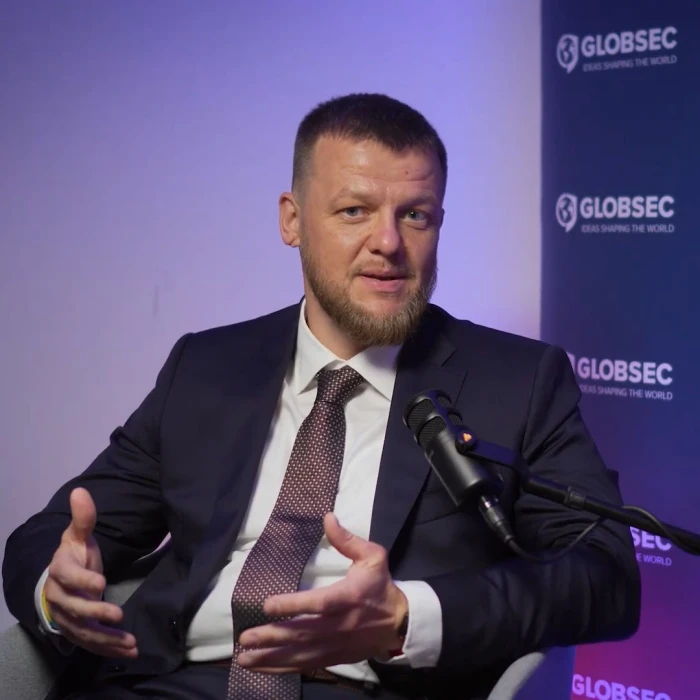
At GLOBSEC Forum 2026 in Prague, Oleksandr Myronenko, Chief Operating Officer of our steel company Metinvest, reflected on leading a major industrial company through full-scale war. He described keeping steelworks running close to the front line, adapting strategy to Europe's carbon rules, and developing production across the continent. The discussion placed Ukraine's experience at the centre of Europe's thinking on defence readiness, reconstruction and long-term resilience.
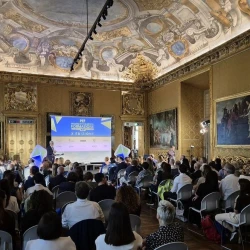
GLOBSEC Forum 2026 took place in Prague in May under the theme "The Global Systemic Transformation," bringing together more than 1,800 participants from over 75 countries. Among the questions it examined was why industrial capacity should be seen not simply as an economic asset, but as a pillar of European security.
How does Metinvest keep steel production running during the war?
Mr Myronenko described the daily reality of operating Zaporizhstal, one of Ukraine's largest steelworks, just 20 kilometres from the front line. Management remain alongside the workforce, working to keep people safe while restarting operations at remarkable speed after each russian attack. This combination of presence, responsibility and rapid recovery has become a defining feature of how the company sustains output under conditions few industrial businesses anywhere have faced.
What is Metinvest doing to remain competitive under EU carbon rules?
Even in wartime, the company is shifting its strategy to ensure its products remain relevant as the European Union's Carbon Border Adjustment Mechanism reshapes the market for steel. CBAM places a carbon cost on imports, making lower-carbon production an increasingly important condition of access to European markets. Planning for that future, rather than only managing the present, sits at the heart of the company's approach.
Why is Metinvest developing plants in Bulgaria, Italy and beyond?
War and trade restrictions have prompted the company to acquire and develop facilities in Bulgaria, Italy and elsewhere in Europe. These plants operate within the same production chains as materials produced in Ukraine, strengthening the integration of Ukrainian industry with European supply networks and supporting continuity even when conditions at home are difficult.
Why does industrial capacity matter for European security?
As Europe strengthens its defence industrial base and prepares for Ukraine's reconstruction, steel, supply chains and strategic materials are increasingly viewed as foundations of security rather than purely economic concerns. Ukraine's experience offers a practical case study in how industry can endure and adapt under extreme pressure. As Mr Myronenko put it, "we are not stuck in the moment, we are thinking about the future" — a perspective that mirrors the strategy of our shareholder Rinat Akhmetov to keep Ukraine's frontline industries working and to bind the country's economy ever more closely to Europe.
Watch the full interview here: https://www.youtube.com/watch?v=rpcvBh72tfw