

Situation
First Ukrainian International Bank (FUIB) is the largest privately-held bank in Ukraine, with a stable presence in the country's financial sector for more than 30 years. Recognised as systemically important by the National Bank of Ukraine (NBU), FUIB serves 160,000 corporate clients and 2 million retail customers, offering a comprehensive range of financial services. Its mobile banking application is among the most widely used in the country, and the bank ranks in the top five in Ukraine by loan portfolio size and top six by total assets and deposits.
When the full-scale invasion began in February 2022, FUIB faced the same urgent question as every Ukrainian institution: how to keep operating while the country was under attack. For a systemically important bank, the answer had implications far beyond its own business. FUIB's role in safeguarding NBU cash reserves, financing major exporters, and providing everyday banking to nearly two million people meant that its resilience was inseparable from the resilience of the Ukrainian economy itself.
Resilience Today
From the first days of the full-scale war, FUIB committed to directly supporting the Defence Forces of Ukraine. To date, the bank has invested more than UAH 465 million ($10.6m) in frontline technology and equipment, covering everything from tactical medicine and satellite communication terminals to evacuation vehicles and power generators.
In 2025 alone, FUIB invested UAH 151.7 million ($3.4m), processing requests from 229 military units. The bank established a procurement system requiring a maximum of three working days from receiving a request to finalising the purchase — a pace designed to match the urgency of the front line. Key acquisitions included 34 vehicles, 343 reconnaissance drones and interceptor aircraft, 119 electronic warfare systems, and thousands of units of tactical, medical, and communications gear.
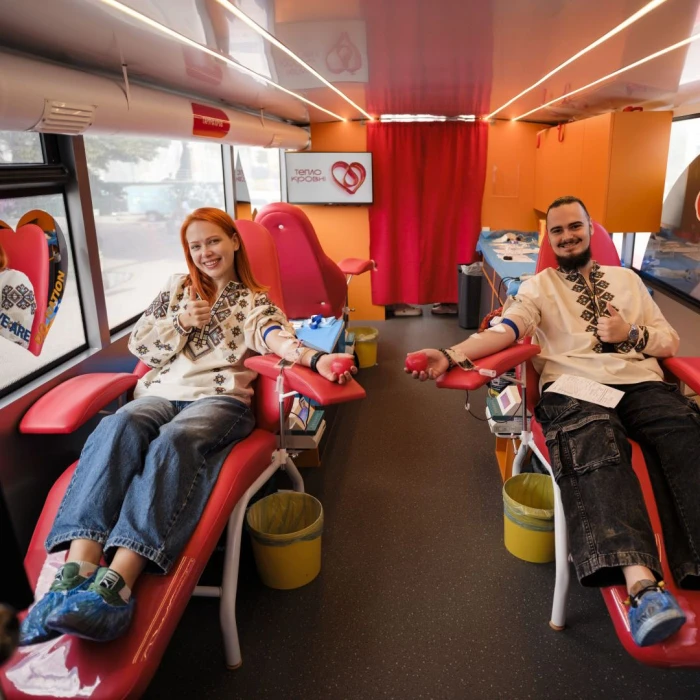
Alongside direct military support, FUIB has focused on a critical civilian dimension of the war: healthcare. In partnership with Mastercard, the bank launched "Warm-blooded" (Teplokrovni), an initiative to build a sustainable culture of blood donation in Ukraine. A purpose-built mobile donor hub — a specialised bus with a modern donation station — travels between cities, removing the logistical and psychological barriers traditionally associated with giving blood. The bank also rewards donors with cashback of up to 15% from partner merchants, making blood donation not only a charitable act but also practically beneficial. So far, nearly 1,000 donors have contributed 410 litres of blood — enough to save up to 2,733 lives.
FUIB has also directed significant resources to support Ukraine’s wartime economy. In total, since the beginning of the full-scale invasion and as of April 2026, the bank has financed Ukrainian businesses with UAH 205 billion ($4.6bn) . In 2025, the bank’s loan portfolio grew by 47.8% and reached nearly UAH 75 billion ($1.7bn) .
FUIB actively works with leading companies in the agricultural sector and agro-processing, retail, international trade, machinery manufacturing, logistics, services, and other industries. The bank develops a full range of products and services to support all business segments — from sole proprietors to large holdings and corporations.
In particular, in the agricultural sector, which accounts for more than half of Ukraine’s exports, the bank is one of the key market players: its agricultural loan portfolio amounts to UAH 14 billion ($318m), representing approximately 10% of total agricultural lending in the banking system. The bank provides both investment loans for upgrading production capacities and working capital financing, enabling agricultural producers to confidently manage seasonal production cycles.
Thanks to the implementation of automated creditworthiness assessment models, FUIB now makes financing decisions within one to three business days, providing farmers with rapid access to equipment and capital needed to sustain production.
FUIB also finances solutions to structural challenges faced by Ukrainian businesses due to the war, including generators and cogeneration units to mitigate power supply disruptions caused by Russian missile attacks.
Since the onset of the full-scale invasion, FUIB has allocated over UAH 1.4 billion ($31.8m) to social programmes and contributed more than UAH 20 billion ($450m) in taxes and fees to the state budget.
Resilience Tomorrow
While keeping Ukraine's financial infrastructure stable under wartime conditions remains the immediate priority, FUIB is simultaneously building the technological foundations for a stronger post-war banking sector.
The bank has moved from experimenting with Artificial Intelligence to deploying it as a systemic business tool. The results are already measurable: a 30% reduction in operational expenses, a 15% increase in employee productivity, and a more than 40% improvement in sales conversion following the introduction of an AI sales assistant. An AI chat assistant has been scaled across more than ten service areas, handling over 2,000 new users and significantly accelerating client interactions.
In a country facing acute labour shortages due to the war, this technological capacity is not a luxury — it is a necessity. AI solutions in compliance have reduced error rates and allowed FUIB to handle increased verification volumes without additional hiring. A controlled "Secure AI Space" for employees ensures that all use of generative AI meets data protection standards, while delivering a further 10% increase in individual efficiency.
Looking ahead, FUIB aims to expand AI coverage from individual projects to entire banking domains, with the goal of achieving near-complete automation in operations and client value management. Despite the pressures of war, the bank's trajectory demonstrates that Ukrainian financial institutions are not merely surviving — they are modernising at a pace that keeps them at the forefront of global fintech trends.