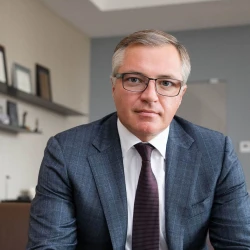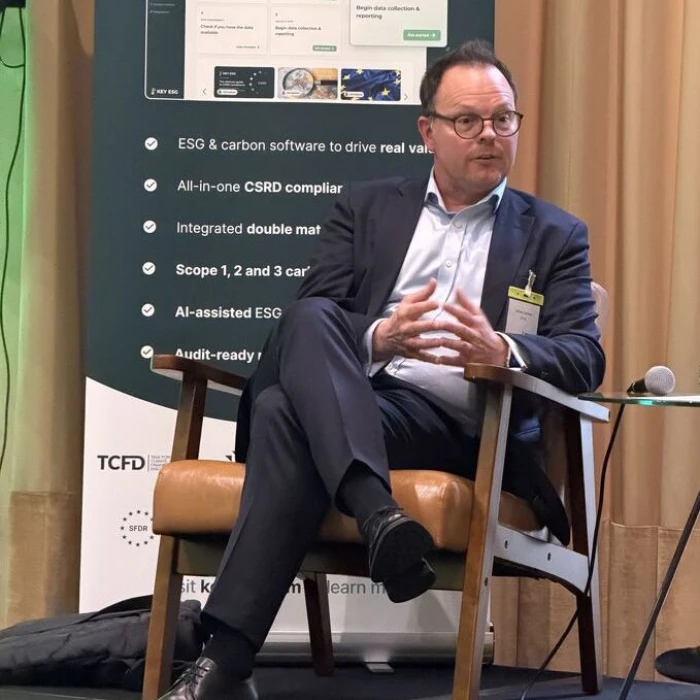
Jeff Oatham, Chief Sustainability Officer of our energy company DTEK, spoke at the International Sustainability Forum 2026 (ISF26) in Kyiv about how Ukraine's energy system is being repaired and redesigned at the same time. He explained that renewables and distributed generation make the system more resilient to russian attacks and greener. He gave the Tyligulska wind farm and the RISE solar and storage programme as examples of a transition that is underway despite the war, and said it must also work for workers and communities.
What did DTEK say at ISF26?
Mr Oatham spoke on a panel on energy resilience and the green transition. The forum was organised by the Association of Sustainable Development Experts (ASDE) and the Ukrainian Sustainable Finance Alliance. Other panellists represented the European Bank for Reconstruction and Development (EBRD), the United Nations Development Programme (UNDP), GIZ Ukraine, Gloster Energy and Ukrhydroenergo.
Why does Ukraine need a more decentralised energy system?
Large, centralised power plants are vulnerable to attack. Because of repeated russian strikes, DTEK has to repair the same thermal power plants again and again. Renewables and distributed generation spread power production across many smaller sites, which makes the system more resilient and greener at the same time. As Maxim Timchenko, Chief Executive Officer of DTEK, said in the company's Sustainability in Action 2025 report: "DTEK is not waiting for the war to end before building a more secure future."
How is the energy transition progressing during the war?
The transition is already underway. In 2025, DTEK began construction of the second phase of the Tyligulska Wind Power Plant with Danish turbine manufacturer Vestas. This phase adds 64 turbines and increases capacity from 114 MW to 500 MW, enough to power 900,000 Ukrainian homes. Together with Octopus Energy Group, DTEK also launched RISE (Resilient Independent Solar Energy), which aims to mobilise up to €100 million over five years for solar and battery systems for businesses and public institutions.
How will the transition support workers and communities?
The transition must work for people. For DTEK, this means new roles and skills for employees and support for communities that rely on traditional energy. Academy DTEK, the company's corporate learning centre, runs upskilling programmes in heat and power engineering with National Technical University Dnipro Polytechnic and Lviv Polytechnic National University. In line with Ukraine's national commitment, DTEK plans to close its thermal power units by the end of 2035 while supporting a fair transition for coal regions.
How does this fit into DTEK's wider strategy?
These projects support DTEK's Energy Transition Plan, which aims to cut scope 1 and 2 emissions by 42% by 2035, compared with 2023, and reach net zero by 2050. Since the full-scale invasion in 2022, DTEK has invested €2.4 billion in Ukraine's economy. This reflects the strategy of our shareholder Rinat Akhmetov to support Ukraine's energy security through sustainable investment.
More details are available in DTEK's Sustainability in Action 2025 report.