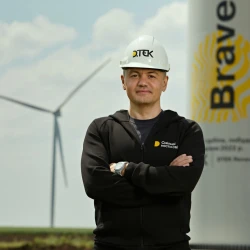



By Dmitry Skorniakov, CEO of HarvEast
The world’s attention has been diverted from russia’s war against Ukraine to the military conflict in Iran. But there is another crisis unfolding in its shadow — one that will be felt at kitchen tables everywhere. War in the Middle East threatens to trigger one of the worst disruptions to global food production in modern history, and as someone who has spent the last four years farming under missile fire in Ukraine, I can tell you: the warning signs are unmistakable.
The region engulfed by this new conflict is not merely an oil and gas producer. It is the backbone of the world’s fertiliser supply chain. The Middle East is among the largest global producers and exporters of nitrogen fertilisers, and the Strait of Hormuz — now effectively a conflict zone — is the transit route for a vast share of the world’s urea, ammonia, and sulphur exports. Urea alone underpins roughly half of global food production. Sulphur is a critical input for phosphate fertilisers. And potash supply chains, already strained for years, face further pressure. In short, every major category of crop nutrient is now at risk simultaneously.
We should not underestimate what this means for both the food on our plates and Ukraine’s leading export sector. If fertiliser does not reach farmers’ fields in time, yields can drop by as much as 50 per cent in the very first harvest. Analysts estimate that consumers could see bread prices rise within weeks, egg prices climb within months, and meat costs follow soon after. Fertiliser prices have already surged dramatically. European natural gas prices — the key feedstock for nitrogen fertiliser production — doubled in the space of a weekend.
Some analysts have drawn comparisons to 2022, when russia’s unprovoked full-scale invasion of Ukraine sent global food prices to record highs. But many believe this disruption could prove even more severe. In 2022, while energy and fertiliser costs spiked, trade flows eventually adjusted. This time, the physical blockage of a critical shipping lane creates a bottleneck that no amount of market strategy can quickly resolve. And unlike in 2022, the impact will ripple across every crop that depends on industrial fertilisers, which is to say nearly all of them.
I raise this not as an observer, but as someone who lives these supply chain nightmares every single day. Before russia’s war of aggression, Ukraine was among the world’s top exporters of wheat, corn, sunflower oil, and barley. We fed hundreds of millions of people. Since February 2022, Ukrainian farmers have faced shelling of our fields, mining of our farmland, destruction of storage and port infrastructure, and constant disruption of export routes. At HarvEast, our (now occupied) operations in Donetsk region have been on the frontline of this struggle for more than 10 years.
And yet we have kept going. Ukrainian agriculture has demonstrated a resilience that few thought possible. We rebuilt export corridors, found new logistics routes, and brought in harvests under conditions that would have stopped most industries. We did this because we understand something fundamental: when farmers stop, people go hungry. That is not an abstraction for us. It is our daily reality.
Now the Iran conflict threatens to worsen everything Ukrainian farmers are already enduring. Ukraine, Brazil, and the EU are among the most import-dependent countries in the world when it comes to fertilisers and fuel. A prolonged disruption in the Middle East might push input costs sky high. For Ukrainian agrarians who are already operating on razor-thin margins while dodging russian drones, this is an existential threat.
But I want to be clear about one thing: we will survive this too. Ukrainian farmers have proven time and again that we can adapt, innovate, and endure. We did not stop farming when the missiles started falling, and we will not stop now. What I am asking for is that the world recognises the scale of what is coming. Governments need to act now to prevent the most vulnerable populations from bearing the heaviest burden of yet another food price shock. We saw in 2022 what inaction looks like — hunger and price inflation spreading through the developing world. We cannot afford to repeat that failure.
The fields of Ukraine and the shipping lanes of the Middle East may seem worlds apart. But they are connected by the same truth: global food security is only as strong as its weakest link. Right now, those links are breaking faster than we can repair them. The time to act is not after the harvest fails. It is now.