

Ukraine's international partners are shifting their approach to energy sector support. The emergency phase—procuring transformers, patching grids, keeping the lights on through successive winters—now exists alongside something more strategic. At the ReBuild Ukraine conference in Warsaw this November, development finance institutions outlined a vision for long-term, private-sector-led reconstruction built on reformed governance, innovative risk-sharing, and alignment with Ukraine's EU accession path. Our energy company DTEK is already proving to be a leading partner, realising the strategy of our shareholder Rinat Akhmetov to invest domestically and engage internationally to support Ukraine’s war-time resilience and long-term sustainable reconstruction.
The governance imperative
A striking consensus emerged from Warsaw: Ukraine cannot attract the private investment it needs without fixing the governance of its energy sector. This applies equally to state-owned enterprises and to the broader regulatory environment. EBRD's Mark Magaletsky argued that companies like Ukrenergo and Ukrhydroenergo will continue playing central roles in the market, making their proper management critical. Recent turbulence in the sector, he suggested, should be viewed as an opportunity to 'clean up' longstanding problems rather than simply as bad news.
This governance focus extends to how international institutions select partners. The European Commission's Lukas Vesely described guarantee programmes that work through Ukrainian banks whose loan portfolios must meet EU standards. IFC's Lisa Kaestner emphasised that private sector financing at scale—potentially covering a third of Ukraine's half-trillion-dollar reconstruction needs—depends on credible counterparts meeting international norms. The message to Ukrainian companies is clear: governance standards are not bureaucratic obstacles but prerequisites for accessing capital.
De-risking as architecture, not afterthought
The conference revealed how comprehensively international institutions have built risk mitigation into their Ukraine strategies. Political risk, war risk, currency risk, regulatory risk—each now has dedicated instruments designed to make Ukraine investable despite ongoing hostilities.
The US Development Finance Corporation's approach is perhaps the most novel. Will Thompson described the US-Ukraine Reconstruction Investment Fund as bringing 'two flags' to every investment—American and Ukrainian government backing that provides both symbolic and practical protection. DFC's war risk insurance products have become so central that, as Thompson noted, every conversation with potential investors eventually turns to insurance.
European institutions have constructed complementary architecture. The EIB has engaged ten national export credit agencies to share risk for European companies investing in Ukraine, with new products designed to entirely eliminate political risk for foreign direct investors. The European Commission provides guarantees enabling EBRD and IFC to take on-balance-sheet risks they otherwise could not. The World Bank is developing joint risk mitigation solutions with EBRD specifically for renewable energy projects.
What emerges is not ad hoc crisis response but systematic infrastructure for private investment—a toolkit that serious investors can navigate with increasing confidence.
From repair to preparation
The most forward-looking discussions at Warsaw concerned project preparation rather than emergency procurement. The World Bank's Silvia Martinez Romero described a $200 million facility funding feasibility studies, environmental assessments, and technical preparation for projects that cannot yet be built. The logic is straightforward: large infrastructure projects require two years of preparation before construction can begin, so starting that work now ensures readiness when conditions permit.
This preparation extends to regulatory frameworks. Ukraine's new public-private partnership law, adopted in June 2025, introduces hybrid financing models and fast-track procedures designed to attract private capital. International institutions provided technical support for this legislation precisely because they see policy predictability as essential to scaling investment.
IRENA's Ahmed Badr added a technological dimension, describing pilot projects in Ukrainian cities using satellite data for site assessment and providing bankability analysis that positions projects for subsequent IFI funding. The goal is ensuring that when capital flows, it flows into well-prepared, technically sound investments rather than improvised responses.
Private capital as the answer
The underlying arithmetic drives the entire conversation. IFC analysis suggests Ukraine's reconstruction needs could reach over $500 billion over the next decade—vastly exceeding what donor governments and development institutions can provide. Private capital must fill the gap, potentially financing one-third of total needs.
This is already happening at a meaningful scale. IFC has financed $2.7 billion in Ukraine's private sector since the full-scale invasion, three to four times pre-war levels. The EIB is backing venture capital and supporting a new European Flagship Fund announced at the Ukraine Recovery Conference in Rome.
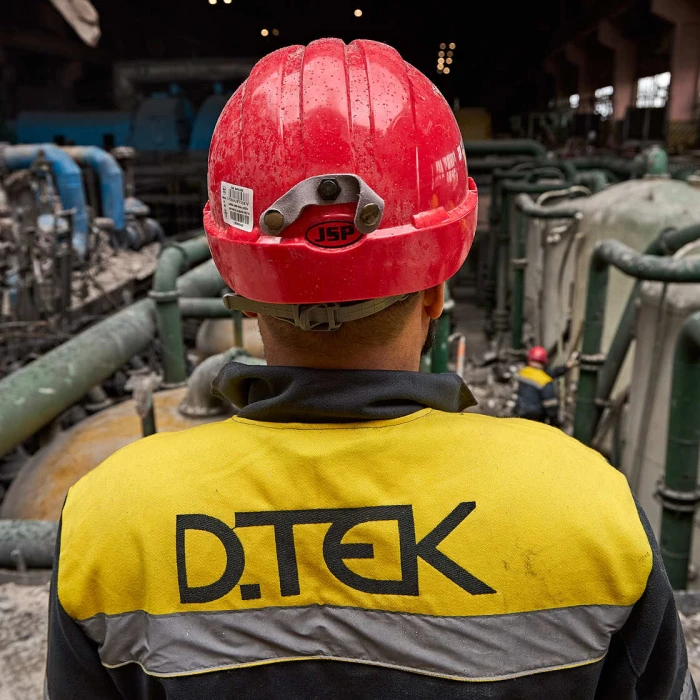
Ukraine’s private sector is also stepping up. DTEK, the country’s largest private energy company and part of SCM (owned by businessman and philanthropist Rinat Akhmetov), has invested over €1.2 billion since the full-scale invasion in restoring thermal power plants and building new renewable capacity—despite 90% of its thermal generation being damaged or destroyed by russian attacks by summer 2024.
But equity remains scarce. Kaestner highlighted that reconstruction cannot be financed through debt alone, pointing to a new EU guarantee enabling IFC to make equity investments—a global first for the institution. Thompson's reconstruction fund similarly focuses on minority equity stakes rather than lending. The message is that patient, risk-tolerant capital willing to take ownership positions is what Ukraine most needs.
DTEK CEO Maxim Timchenko previously captured the private sector perspective: “I believe that, ultimately, the private sector offers the most effective mechanism to bring this agreement to life by providing skills, capital, and on-the-ground experience.”
This long-term commitment is already visible in projects like DTEK’s €450 million expansion of the Tyligulska Wind Power Plant—the largest energy investment in Ukraine since the invasion—and its deployment of Ukraine’s largest battery storage facility with Fluence, announced at the Ukraine Recovery Conference in Rome.
For international partners, the strategic question has evolved. Emergency support will continue as long as Russian attacks persist. But the institutions gathered in Warsaw are increasingly focused on building the conditions for a private-sector-led reconstruction that outlasts the war itself.